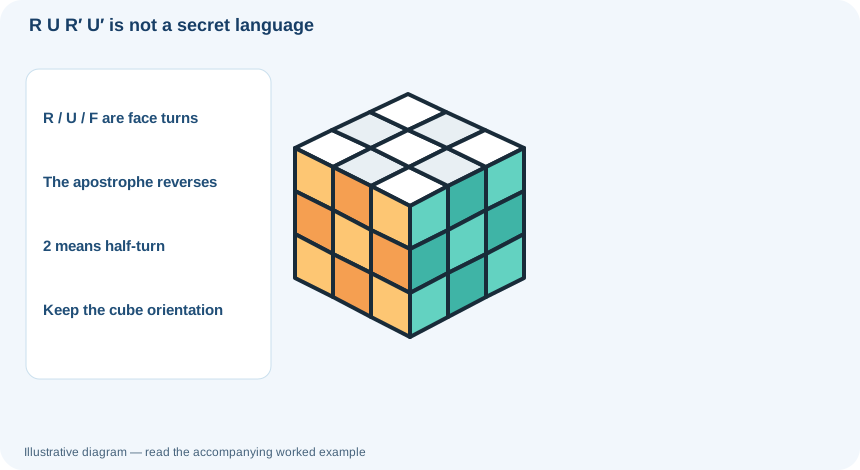
Start with the face you turn
The six letters name faces: R right, L left, U up, D down, F front and B back. Hold the cube in a steady orientation. The letter describes a quarter turn clockwise as you look directly at that face, not from a fixed view of the whole cube. That last detail catches many beginners on the left and back faces.
Two tiny symbols change everything
An apostrophe after the letter means turn that face in the opposite direction. A 2 means turn it halfway around. Try R and then R′ on a solved cube; the second turn undoes the first. Try U2; the top face makes a half turn regardless of clockwise direction.
Read sequences in small groups
The common sequence R U R′ U′ is four instructions, not one long gesture. Repeat it slowly while watching one corner piece travel. Bring the cube back to the same orientation each time. Once you can explain the effect of each move, memorising becomes much less mysterious.
A clockwise turn depends on where you stand
The term clockwise is easy when you look straight at the right face, but confusing when the face points away from you. For B, the back face, imagine moving your eyes behind the cube to look directly at that face. B is clockwise from there, not necessarily from your usual front view. This is why diagrams often use arrows. When learning, take one face at a time and compare a move with its inverse until they feel symmetrical.
Practice one sequence without rushing
Keep the same top and front centres facing you. Turn R once, then U, then R′, then U′. Stop and inspect where a particular corner has moved. Reverse the sequence carefully and see whether your observations agree. You can learn a great deal without scrambling the entire puzzle. A written sequence only becomes useful when you know what stays fixed, what moves, and which direction the apostrophe changes.
The grip is part of the instruction
A printed move such as R′ assumes you have kept the same orientation of the whole cube. If you rotate the entire cube halfway between moves without accounting for it, “right” may refer to a different face. While practising, keep the front and up centres facing in fixed directions and say which face you are turning. Later you will learn whole-cube rotations such as x, y and z; they deliberately change this frame of reference. Learning to separate a face turn from a whole-cube rotation is a small skill that prevents a surprising number of beginner errors.
Test what the symbols actually mean
Before memorising an algorithm, perform R followed by R′ from the same cube orientation. The second turn must undo the first, returning every sticker to its previous position. Try R2 twice: two half-turns also restore the initial state. If your result differs, check whether you rotated the whole cube between moves. Face letters refer to the cube orientation, not an arbitrary fixed side of the screen.
Reverse the entire sequence
The inverse of R U F is F' U' R', not R' U' F'. Reversing only each turn while keeping the original order does not generally undo the sequence. Practise by performing a short sequence followed by its true inverse and verifying that the original cube state returns.