Hands-on training · 3×3 cube
Rubik 3×3 practice worksheet: notation, inverses and layer checks
Understand what a move does before memorising its letters. Answer the exercises, print a separate worksheet and try each idea on a real cube.
What you will learn
Read R, U, F, L, D and B from the named face, understand prime and half turns, reverse move sequences without guessing, and inspect pieces against their neighbouring centres.
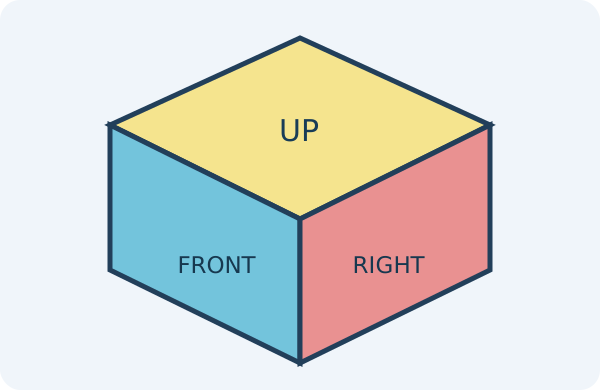
Rules to learn first
Each letter specifies the face being turned. Clockwise means clockwise when looking directly at that named face, not always from the cube's front. Prime (') reverses a quarter turn, while 2 means a half turn. To invert a sequence, reverse its move order and invert every move.
R U R′ U′ · U R U′ R′ · F2
Check your understanding: six questions
Choose one answer per question. Feedback explains the rule without leaving the page; you may retry.
2. What does U2 mean?
3. What is the inverse of R U?
4. What confirms a correctly made white cross?
5. How many colour stickers does a standard 3×3 corner piece have?
6. Which move is the inverse of F2?
Choose an answer to begin; no personal information is collected.
Check the first layer on a real cube
- Identify all six face centres without turning a face. A centre defines the destination colour.
- After the white cross, check that each edge's side sticker matches its neighbouring centre.
- After inserting white corners, inspect the side colours—not just the white face.
- If a step goes wrong, restore your working orientation and inspect your last move instead of guessing a new algorithm.
Continue learning
Use the 3D Academy to see which pieces move, then return to the worksheet and explain each turn in your own words.