Orientation is about direction
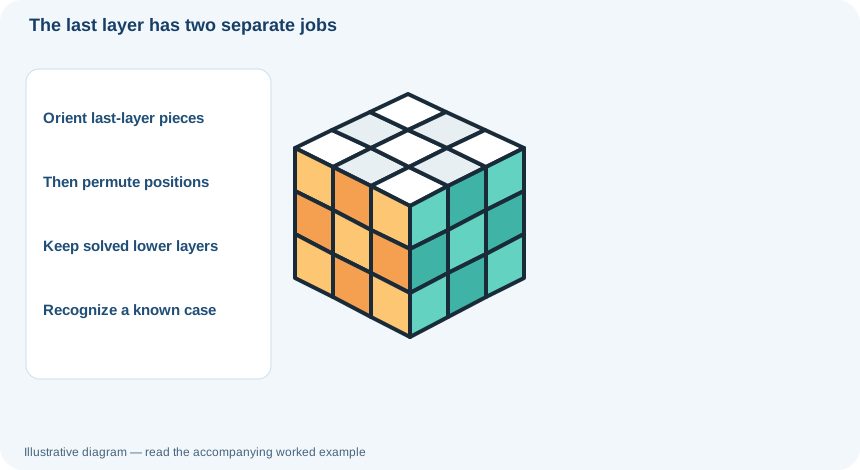
After solving two layers, the remaining stickers on top may point in different directions. The first task is orientation: get the final-layer pieces facing the right way, such as bringing the yellow stickers to the top. This need not place each piece in its final home.
Permutation is about location
Next ask whether each edge and corner actually sits between the centres whose colours it belongs with. Moving already oriented pieces into their correct positions is called permutation. Mixing the two questions makes the last layer feel like endless random turning.
Why algorithms exist
A short sequence can change the orientation or permutation of selected pieces while preserving much of the solved cube. An algorithm is useful not because it is fast to recite, but because you understand what it is designed to disturb and what it preserves. Practise one case, reset the cube, and recognise it again before moving on.
Recognise a case before turning
Suppose the top face has a yellow cross but the four yellow corners do not yet point upward. You have an orientation problem, not necessarily a permutation problem. A sequence that twists corner orientations should be chosen with that goal in mind. Once all yellow stickers face upward, the corners can still occupy the wrong places around the cube; that is when position matters. Separating those questions makes the final stage less mysterious and reduces the temptation to twist at random.
Preserve what is already solved
A good last-layer method is built from sequences that deliberately protect the first two layers. Turn the cube to the indicated starting orientation, carry out the sequence carefully, and inspect both the last layer and the protected work afterward. If the lower layers are scrambled, the issue may be a misplaced turn or a wrong starting grip. Repeat the same case until you can predict which pieces will cycle. Recognition is more valuable than memorising many formulas in one sitting.
A good algorithm has a purpose
Instead of memorising a final-layer sequence as a string of letters, describe its aim before executing it: “orient these corners without disturbing the completed layers,” or “cycle these three edges while preserving their orientation.” Then look for evidence that the promised change happened. If the effect is different, the problem may be an incorrect starting orientation rather than bad memory. Try keeping a short notebook that records the starting pattern and expected result of each sequence. Recognition and verification gradually reduce dependence on a list of mysterious formulas.
Two separate checks before solving the final layer
Once the top appears yellow, inspect the two visible side colors of each upper-layer piece. Ask first whether it is oriented correctly, then whether it occupies the correct position relative to the adjacent centers. Both are necessary. A fully yellow upper face can still have pieces permuted incorrectly; repeating an orientation algorithm without checking the case may undo earlier progress.
Define the remaining task
After obtaining a solid yellow top, compare all four side faces with their centers. If pieces point correctly but sit at the wrong places, the unfinished task is permutation rather than orientation. This distinction prevents repeated use of algorithms designed for an already completed objective.