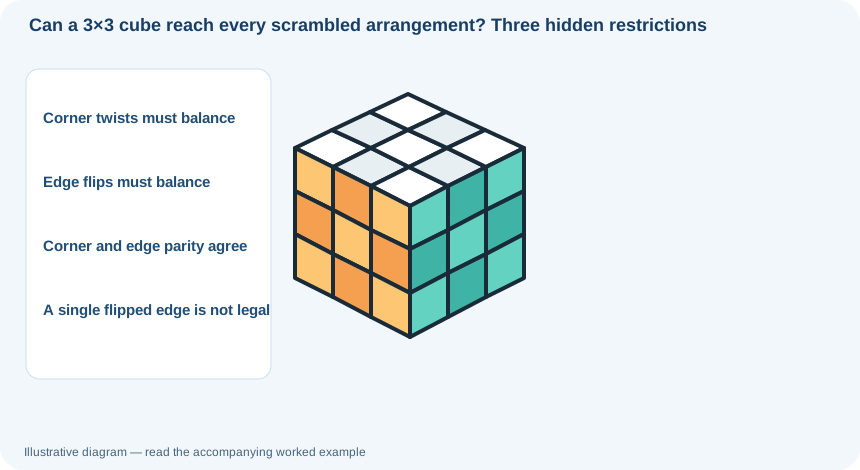
Not every arrangement is a legal scramble
A 3×3 Rubik's Cube is not just twenty moving pieces in arbitrary places. It has eight corners and twelve edges, and ordinary face turns preserve some relationships between those pieces. If the cube was assembled correctly and only legal face turns were used, it can never reach a state with exactly one corner twisted in place or exactly one edge flipped in place. This matters when a nearly solved cube seems to demand a maneuver that none of the familiar algorithms can provide. Before assuming the puzzle is unusually difficult, verify that the state is mechanically possible.
Corner orientation balances modulo three
Each corner has three possible orientations relative to its correct slot. In a consistent orientation convention, assign each a twist value 0, 1 or 2. For every legally scrambled 3×3, the sum of these twist values is divisible by 3. This does not mean the cube must have three visibly twisted corners; different twists can balance each other. It means that rotating just one corner by 120 degrees while leaving all other pieces untouched cannot be produced by face turns. The rule is about the cube's full state, not a trick inferred from looking at one sticker.
Edge flips must come in a balanced total
An edge has two orientations, often represented by flip values 0 and 1. Legal 3×3 turns always preserve an even total number of edge flips under a consistent orientation convention. If the entire cube looks solved except for one edge whose stickers are reversed, there is no legal sequence of face turns that repairs only that edge. You might have accidentally twisted a physical piece or reassembled the puzzle in a different orientation. Checking the edge colours against the fixed centres helps distinguish an unfamiliar scramble from an impossible one.
Corner and edge permutation parity must agree
Rearranging pieces can be described by permutations. Every permutation is even or odd, according to how many pairwise swaps it takes to reproduce it. On a legal 3×3, the corner permutation and edge permutation always have matching parity. Consequently a solved cube with only two edge pieces swapped—and all corners left perfectly fixed—is not a reachable face-turn state. Swapping two corners alone has the same problem. You do not need to calculate permutation parity while speedsolving; the invariant is a diagnostic tool for a suspicious last-layer state.
Why parity problems appear on a 4×4
A 4×4 cube has movable centres and edge pieces that are paired during reduction to a 3×3-like puzzle. After reduction, an edge pair can appear flipped relative to the 3×3 orientation convention, or the last-layer permutation can appear to have an odd swap. These are familiar 4×4 parity cases and do not imply that the physical 4×4 cube was assembled incorrectly. Their algorithms operate on the 4×4's additional degrees of freedom. Do not apply the diagnosis of a mechanically impossible 3×3 state directly to a properly scrambled 4×4.
A simple diagnosis before attempting a repair
If a cube refuses to finish, first confirm the puzzle size, the colour scheme and whether every centre belongs where you assume. Next verify whether a turn notation error is the real culprit: R' is not R, and rotating the entire cube changes how you interpret later moves. If the 3×3 is solved except for one clearly twisted corner or one flipped edge, stop trying random algorithms. Check whether someone previously opened, reassembled or manually twisted a piece. If you are unsure, consult a reliable cube-state checker rather than forcing the hardware or inventing a sequence.
Separate a scramble from a physically changed cube
A legal 3×3 face-turn sequence cannot create every imaginable arrangement of stickers. A position that appears to contain one twisted corner or one flipped edge may indicate a physical reassembly or sticker problem. Verify piece identity and cube orientation carefully before concluding that the puzzle is impossible.