The comforting illusion
A new solver often celebrates when all nine stickers on one face share the same colour. It is a genuine milestone, but it may conceal a problem. Some of the corner or edge pieces can be turned into the wrong positions while still presenting that colour on top.
Check the side stickers
On a standard 3×3 cube, centre pieces tell you which colour each face should become. When your white cross is built, inspect each white edge’s second colour and make sure it matches the centre of the side beneath it. Do the same for each white corner: its two side stickers must fit their neighbouring centres.
Build something you can keep
A correctly solved first layer has matching top stickers and a matching row of side colours around the cube. Only then move to the middle layer. This extra inspection may feel slow, but it prevents a common cycle: solving a pretty face, disrupting it to fix the sides, then starting over.
Look below the finished face
Hold your solved white face on the bottom. Along the lowest row of each side face, the colour should match that side’s centre. If one red-and-white edge sits beneath the blue centre, the top white sticker can look perfect while the edge belongs elsewhere. Correcting that edge later may disturb the work above it, so inspect the sides now. This test takes one rotation of the whole cube and saves a surprising amount of rework.
Build the cross with side colours in mind
Rather than making any white cross and worrying about the side colours at the end, identify the second colour on each white edge before inserting it. Align that colour with its centre, then place the edge so that white also faces the chosen solved face. The result is a cross that already agrees with the neighbouring faces. When you insert corners, apply the same discipline: the three colours on a corner tell you exactly which three centres surround its correct position.
Test one corner instead of the whole cube
Suppose the white face looks finished, but a white-green-red corner sits between the green and orange centres. That corner cannot be correctly placed there because its red sticker belongs next to the red centre. You can identify the mistake without turning anything: read the colours of the piece and compare them with the centres surrounding its location. Repeat this inspection for the four first-layer corners. Once you can perform it without effort, solving a layer becomes more reliable than collecting matching stickers on one face.
Distinguish one face turn from a cube rotation
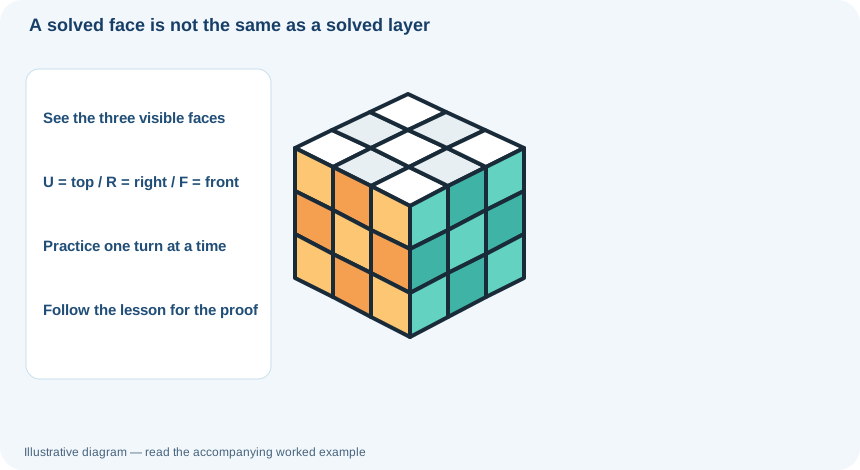
Hold the cube with F toward you and U on top. An F turn rotates the front layer while the rest of the cube keeps its orientation. A whole-cube y rotation changes which physical face you call front, right or back. These operations are not interchangeable: a face turn changes the cubies relative to the centers, while a whole-cube rotation changes the viewing frame. Keep track of the front center before interpreting a longer algorithm.
Look around the cube
A fully white face can coexist with mismatched side bands. Rotate the whole cube in your hands without turning a face and check whether each edge and corner sticker in the first layer aligns with the neighboring center. This is a stronger completion test than looking down at the white face alone.