Why CFOP treats two layers together
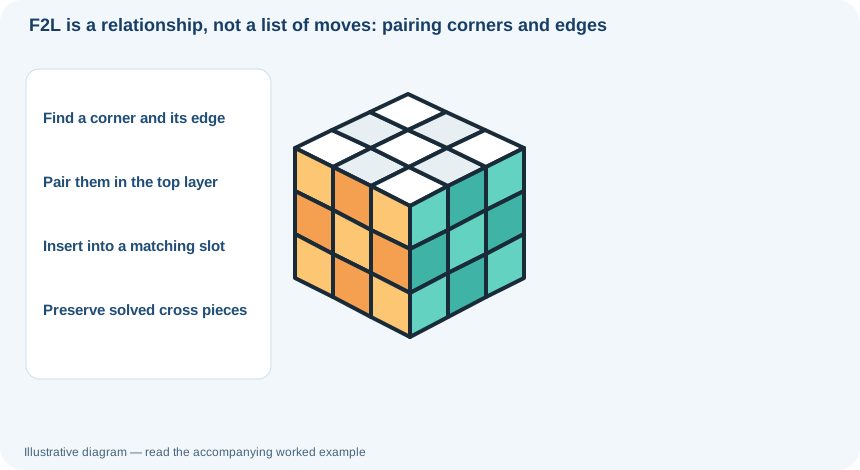
In the CFOP method, the cross is usually solved on the bottom. The next stage is First Two Layers, shortened to F2L. Rather than completing every first-layer corner and then searching for its second-layer edge, an F2L solver tries to match the corner and edge that belong to the same slot and insert them as one unit. The approach can reduce repeated moves and improve look-ahead, but it is not necessary for a beginner to memorise dozens of cases before understanding the underlying cube structure.
Find the destination before touching pieces
A corner is identified by its three sticker colours and an edge by two. With white on the bottom, a white–red–blue corner belongs with the red–blue edge in the slot between the red and blue centers. The centers tell you where the pieces belong; their current positions only tell you how to approach them. A common beginner error is to pair two pieces that happen to be adjacent on the top layer without checking that their colour sets match. Adjacent is not the same as belonging together.
Recognise paired, separated and trapped cases
There are three useful questions before an F2L insertion. Are the corner and edge already paired correctly on the upper layer? Are they separated, so a short sequence could bring them together? Or is one piece trapped in a solved or unsolved lower slot? In the last case you may have to extract the piece before pairing it. The exact moves depend on orientation and available free slots; there is no universal four-move sequence that solves every corner-edge case. Treat a 'trigger' as a tool to understand, not a substitute for looking at the stickers.
Protect solved slots
When experimenting, keep the solved cross on the bottom and watch which slot your turns disturb. A short right-hand trigger such as R U R' may lift, shift or restore particular pieces depending on where they started; it is not automatically an F2L solution. Before a move, predict what happens to the target pair and to an already finished slot. If your new pair is correct but you broke two completed pairs, you have not made useful progress. Early F2L practice is often about controlling side effects rather than chasing speed.
Build recognition with one slot at a time
Solve the cross, then pick one front slot. Identify its corner and matching edge by sticker colours, without making any turns for ten seconds. Decide which of the three situations you see: paired, separated or trapped. Try to connect the two pieces, insert the pair and check that the cross still matches the centers. Then scramble and repeat with the same slot before rotating to a different slot. This isolates recognition from hand speed, making mistakes easier to diagnose.
A useful boundary for memorisation
Once you can say where each corner-edge pair belongs and why an insertion preserves earlier work, memorised alternatives become valuable. Compare two valid ways of handling the same case: count their turns, watch whether you must rotate the whole cube, and check how quickly your eyes can find the next pair. Fast solvers optimise recognition, finger tricks and continuity together. The first milestone for learning F2L should be four correct pairs with the cross intact—not a stopwatch reading that hides repeated mistakes.
Identify the pair before moving it
A white–red–green corner and a red–green middle edge share a destination. Do not try to pair that corner with a red–blue edge simply because both carry red. Compare all relevant stickers with the side centers before beginning a setup or insertion.