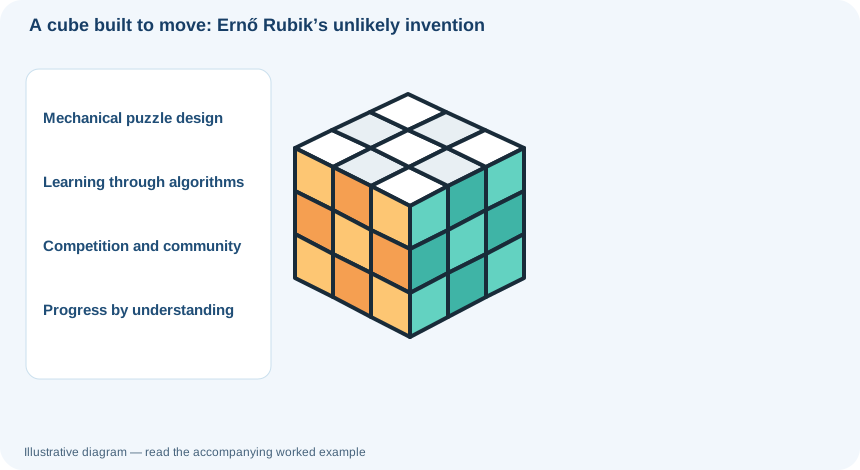
The puzzle began as a question about movement
In Budapest in 1974, Ernő Rubik made a small object whose parts could turn around one another without the whole structure falling apart. He was interested in three-dimensional form and how pieces relate in space. The difficulty of returning the colours to their original positions turned the object into a puzzle.
The hidden mechanism mattered
It is easy to focus on the coloured squares, but the invention rests on the internal mechanism. The cube’s faces can turn while its core keeps the pieces together. Rubik obtained a Hungarian patent for the mechanism in 1975. Early versions were sold as the Magic Cube.
From local curiosity to worldwide puzzle
The object acquired the Rubik’s Cube name and reached international markets in 1980. It was strangely democratic: you could understand what needed to be done in seconds, yet knowing the goal did not tell you how to reach it. The coloured cube appeared in homes and classrooms and became an icon of the decade.
A competition, and a different kind of mastery
The first world championship took place in Budapest in 1982. Solving quickly came to mean much more than turning randomly: competitors developed recognition, finger technique and repeatable sequences. The original object still rewards slower learners, though. A first solved face is satisfying precisely because the other faces refuse to stay put.
Start with the move notation, then learn why solving in layers works. Speed can wait.
A mechanism you can feel in your hands
A cube from the early days made the surprising promise that pieces could move around a fixed core while remaining attached. That is easy to take for granted now. Pick up a modern 3×3 cube and turn one face slowly: corners and edges exchange places, but the six centres establish a stable frame of reference. The colours make the puzzle readable; the construction makes it possible. Remembering that distinction gives the invention its due and explains why reproducing its feel has been an engineering project in its own right.
Why a solved cube is memorable
The apparent simplicity of the goal contrasts with the vast number of possible arrangements. Beginners discover quickly that restoring one face can disturb another. This tension invited families to compare methods, competitors to practise, and teachers to use the object when talking about spatial reasoning. The historical appeal does not rest only on the fastest recorded solve. The object is interesting because every twist is visible, reversible, and entangled with several other pieces at once.
An object with more than one kind of audience
The same cube attracted very different people. For some it was a physical challenge: could they return the colours without instructions? For others, especially in classrooms, it suggested ways to discuss symmetry, orientation and the relationship between parts of a three-dimensional object. Competitive solvers later made efficiency and recognition central. None of these uses cancels the others. Pick up a cube today and it still offers the original question: if one movement changes several things at once, how can you make progress without undoing earlier progress? That question explains more of its lasting appeal than nostalgia alone.
Read invention history alongside mechanics
The cube's enduring educational value comes from how legal face turns rearrange pieces while preserving the underlying mechanism. Reconstructing a corner's path through two moves is a useful way to connect the story of a puzzle with the mathematical constraints it demonstrates.
Understand the reasoning behind this lesson
From mechanical puzzle to learning tool
The Rubik Cube is not simply six colored faces. A standard 3×3 has fixed centers, movable edges and corners, with piece positions constrained by the mechanism.
When comparing historical cube designs, focus on what the internal mechanism permits rather than assuming any sticker arrangement can be reached by turns.
Apply the idea to your next solve
Inspect a real 3×3 cube: identify one centre, an edge with two stickers and a corner with three. Each type is constrained by the mechanism, not merely by a colour pattern.
Compare that arrangement with a 2×2 cube, which has corners but no visible centre or edge pieces. This is a practical way to connect the history of the puzzle with its physical construction.